Golf basics for beginners
Golf 101: Everything a New Player Should Know Before the First Round
Your first-round cheat sheet: how holes work, what the basic words mean, and how to look comfortable even when you're brand new.
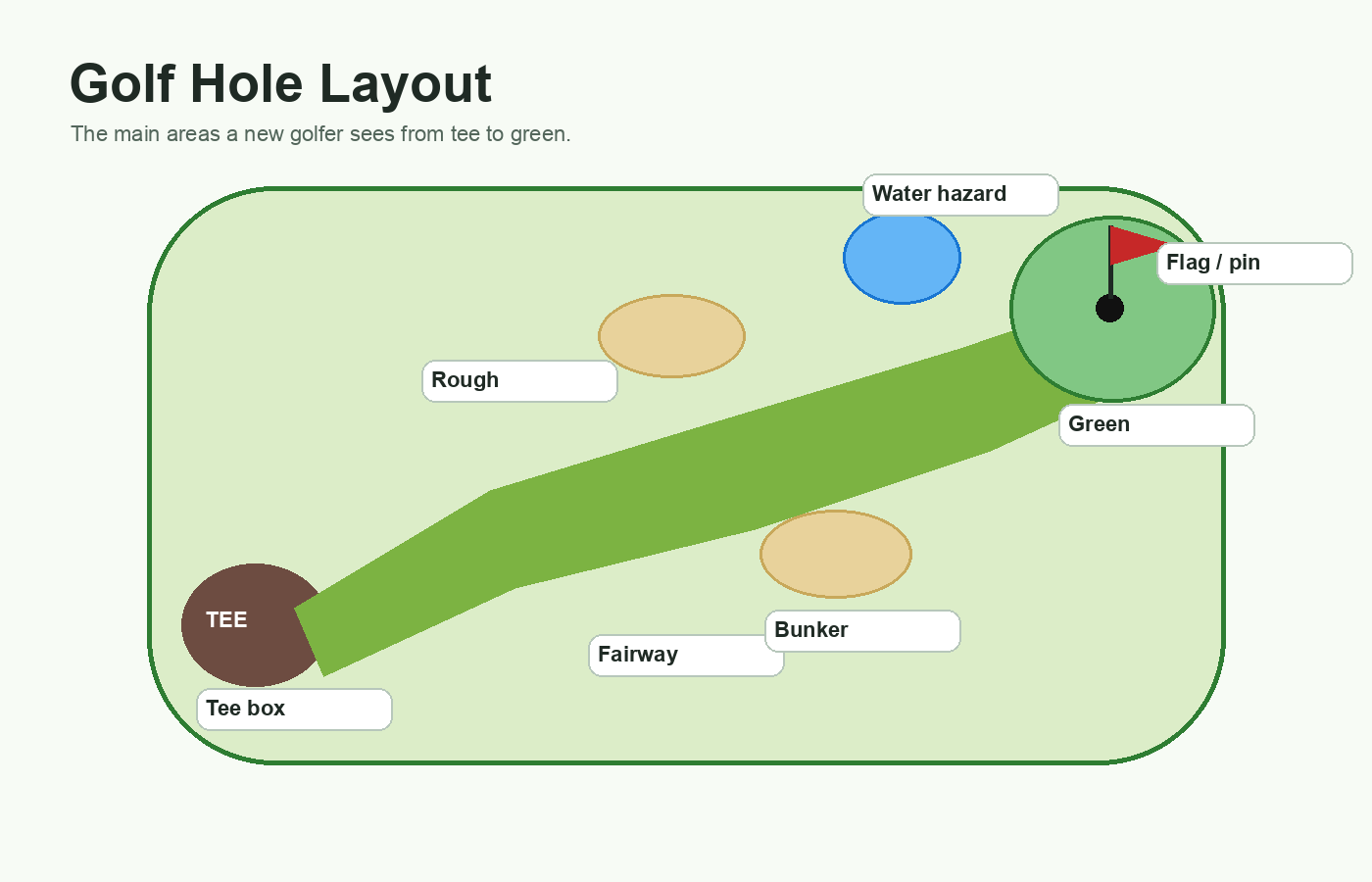
Start with the point of the game
Golf is simple at heart: move the ball from the teeing area into the hole in as few strokes as you can. A hole usually gives you a tee box, fairway, rough, hazards such as sand or water, and a green with the flagstick in the cup. Your ball might travel 180 yards, 18 yards, or dribble off the toe of the club; if you meant to hit it, it counts.
For a first round, don’t judge yourself by par. Judge yourself by whether you kept moving, stayed safe, and learned where the ball tends to go when you swing freely. A new golfer who advances the ball, keeps a good attitude, and plays at a healthy pace is already doing the important part well.
Par without the pressure
Par is the score a skilled player is expected to make. A par 3 might call for one shot to the green and two putts. A par 4 usually asks for a tee shot, an approach, and two putts. A par 5 gives you more room to advance the ball in stages.
You’ll hear these terms often:
- Birdie: one stroke under par.
- Par: the expected score.
- Bogey: one over par.
- Double bogey: two over par.
- Penalty stroke: an added stroke for certain situations, such as a lost ball or a ball in a penalty area.
Beginner rule of thumb: if a hole turns into a mess, pick up at double par and enjoy the walk to the next tee.
What you actually need
You can carry 14 clubs, but you don’t need 14 decisions. A driver or hybrid, a mid-iron, a wedge, and a putter are enough to learn the shape of the game. Add balls, tees, a glove if you like one, water, and shoes with decent grip. Borrowing or renting is normal; nobody sensible expects a newcomer to buy a custom set before knowing whether they like the game.
A first-round bag can be very simple:
| Item | Why it helps |
|---|---|
| 6-10 golf balls | New players lose balls; it is part of the day |
| Tees and ball marker | Small things you will need constantly |
| Glove | Optional, but useful for grip and comfort |
| Water and snack | Energy matters more than you think |
| Towel | Wet grass, sand, and muddy balls happen quickly |
| Light jacket or sunscreen | Weather changes the mood of a round |
The little words that save confusion
A tee shot starts the hole. The fairway is the shorter grass you’re hoping to find. The rough is longer grass that makes contact harder. Your lie is how the ball sits. The green is for putting. The pin or flagstick shows where the hole is cut.
A few more terms make the first round easier:
- Away: the player farthest from the hole usually plays first.
- Fore: shout it loudly if a ball may hit someone.
- Mulligan: an informal do-over; only use it if your group agrees.
- Ready golf: in casual play, the safe player who is prepared can hit to keep pace moving.
How a beginner should play a hole
Think in stages instead of perfect shots. On a par 4, your best plan might be hybrid toward the fairway, 7-iron or wedge back into position, chip onto the green, and two putts. That is real golf. You do not have to reach every green in regulation to belong on the course.
If the ball goes into trees, choose the easiest route back to short grass. If a bunker shot looks scary, take enough sand and just get it out. If water guards the green, aim at the dry side and accept a longer putt. Your first rounds are about learning which choices keep the hole playable.
Etiquette that makes you easy to play with
Golf etiquette is mostly awareness. Stand still and quiet when someone swings. Keep your shadow away from another player’s putting line. Rake bunkers, repair obvious ball marks, and replace divots when the course asks you to. Park the cart or place your bag where you can leave quickly after putting out.
The most appreciated beginner habit is pace. Be ready when it is your turn, carry an extra ball, and pick up when the hole stops being useful. If you are unsure what to do, ask. Most golfers would rather answer a quick question than watch someone feel embarrassed in silence.
First-tee nerves are part of it
Show up early, take a few half-swings, and aim for contact rather than distance. If you’re worried about holding people up, tell your group you’re new. Most golfers remember their first nervous tee shot and will happily point you in the right direction.
Try this first-tee routine:
- Pick a big target, such as the middle of the fairway or a distant tree.
- Make one relaxed rehearsal swing.
- Set the clubface behind the ball before arranging your feet.
- Swing at a speed that lets you hold your finish.
- Watch where the ball goes, then walk after it with no apology.
What counts as a good first round
A good first round is not a number. It is finishing with a few shots you want to hit again, a clearer sense of which club does what, and enough energy to say yes when someone asks you to play another nine. Celebrate the solid 8-iron, the two-putt from long range, the chip that stayed on the green, and the hole where you made a smart decision after a bad swing.